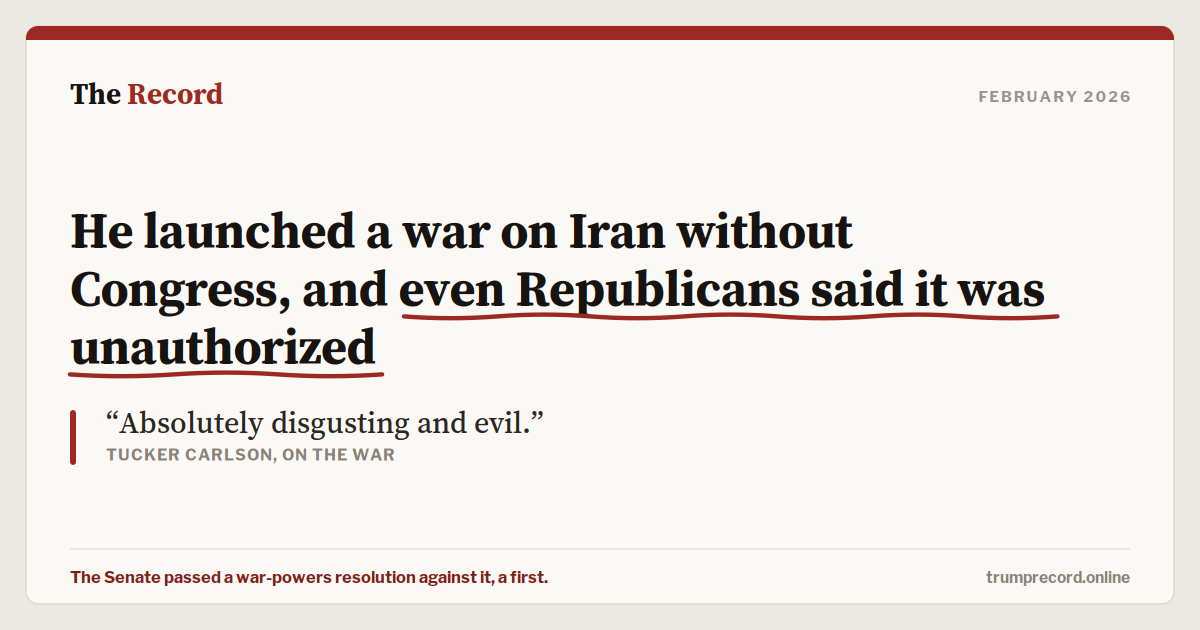
The Constitution gives Congress the power to declare war. On February 28, 2026, he ordered strikes on Iran aimed at overthrowing its government without congressional authorization. Republicans Thomas Massie and Rand Paul called the strikes acts of war unauthorized by Congress, and the Senate passed a war-powers resolution against it, the first time such a measure cleared both chambers. The revolt ran through MAGA media too: Tucker Carlson called the war “absolutely disgusting and evil,” and Marjorie Taylor Greene said “we voted for America First and ZERO wars.” Months in, the war he began without authorization had drawn down US air defenses. The nonpartisan Center for Strategic and International Studies estimated the military had already fired more than 60 percent of its Patriot and THAAD interceptors, the systems that defend US troops and Gulf allies. The chairman of the Joint Chiefs, General Dan Caine, a Trump appointee, had warned him before the strikes that US stockpiles could not sustain a prolonged fight. Trump waved off the concern, insisting the United States has “far more munitions than anyone in the world, and far more than we need.” Days later, his own Pentagon undercut the claim: the deputy defense secretary gave weapons makers 21 days to plan a rapid increase in production of the munitions the war had drained, a memo the Pentagon confirmed was real.
SourcesLaunched without authorization, NPR · Massie's GOP-backed war powers resolution (Fox News) · Rand Paul (R): opposed from the start (The Hill) · MAGA revolt (ABC) · Interceptor depletion, CSIS estimate (CNN) · Trump: far more than we need (Al Jazeera) · Caine warned Trump before the strikes (Washington Post) · Pentagon’s crash-production memo, confirmed (Washington Post) · Pentagon confirms the memo (AP via Business Standard)